Custom Search
Showing posts with label National Monument. Show all posts

Tuesday, April 9, 2019

Visit the Domus Municipalis of Bragança - Santa Maria (Bragança)

The Domus Municipalis is located in the parish of Santa Maria, in the city of Bragança. It stands out as the only example of Romanesque civil architecture in the Iberian Peninsula.
It was built in the 12th century. In stone masonry, it presents plant in form an irregular pentagon. It has an underground, which houses a vaulted cistern. It served as a water cistern, but there are doubts as to whether this would have been its original function.
The designation because it is known today (in Latin "Domus Municipalis", in Portuguese language "Municipal House") is due to have been used as Paços do Concelho by the Municipal Administration of Bragança.
It is classified as a National Monument.

Tuesday, February 19, 2019

Visit the Basilica of Santo Cristo - Outeiro (Bragança)

The basilica of Santo Cristo do Outeiro is a church-sanctuary in the Parish of Outeiro.
This basilica is a national monument since 1927 and received on July 12, 2014 the title of minor Basilica, attributed by the Congregation for Divine Worship and Discipline of the Sacraments.
It began to be built in 1698. Although the temple was open to worship from May 3, 1713, it was only effectively completed in 1739.
The architecture of the temple is distinguished by the symmetry and balance of proportions. It follows a baroque model inspired by the Manueline architecture, with the main source being the church of the Monastery of Santa Maria de Belém, in an attempt to revive the golden period of the discoveries before the Philippine dominion.
The main façade is inspired by the church of the Monastery of São Vicente de Fora. It is torn by a magnificent twinned portal, surmounted by a large rosette and flanked by two bell towers with a pyramidal finish.
The interior, of baroque taste, is typical of the church-hall. The altars of polychrome and gilt carving stand out.
In the sacristy stand the paintings of coffins by the Valistolean painter Damião Bustamante, made in 1768 and also following a seventeenth-century revivalist trend.

Thursday, January 10, 2019

Visit the Church of São Bento - Castro de Avelãs

The Church of São Bento, located in the Parish of Castro de Avelãs is one of the most symbolic monuments of the Transmontano Northeast, simultaneously illustrating the Romanesque art and the monastic life of the region.
From the primitive Romanesque project, the head remains, tripartite and staggered both in height and in size. Of semi-circular plan of two sections, the chancel and the apsolos are a unique work in our Romanesque art. Contrary to what was common in medieval Portugal, the material used was brick, a material much less expensive than stone. The outer walls are decorated with large blind arches, with double arch in the center, which rhythms horizontally all the elevations. The decoration used is strictly geometric, with protruding frames and friezes on sawtooth teeth.
At the time of its construction, the church had great monumentality, since it foresaw a plan of three ships (of which there is still the beginning of a lateral ship) and a harmonic facade with two towers flanking a central body.
Inside, in the right apse, there is the tomb of D. Nuno Martins de Chacim, executed around 1262 and decorated only with heraldic motifs and an unfinished epitaph.
This Church is classified as a National Monument.

Thursday, July 5, 2018

Visit the Cathedral of Braga - Sé (Braga)

The Cathedral of Braga is located in the parish of the Cathedral and is the seat of the bishopric founded, according to tradition, by St. James the Greater who here left his first disciple, St. Peter of Rates. Due to this apostolic origin it is considered Sacred Primal Basilica of the Iberian Peninsula, and its Archbishop, Primate of the Spain. It has its own liturgy, the Bracaran liturgy.
This is one of the most important Romanesque temples in the country. Here you will find the tombs of Henry of Burgundy, Count of Portugal and his wife, Teresa of Leon, the country of D. Afonso Henriques.
Its better documented history dates back to the work of the first bishop, D. Pedro de Braga, and corresponds to the restoration of the Episcopal See in 1070, which preserves few vestiges.
In 1128 a building of five chapels was begun at the head of the church, on the initiative of Archbishop D. Paio Mendes, partially destroyed by the earthquake of 1135. Respecting the architectural canons of the Benedictine cloneans, the works were directed by Nuno Paio.
In 1268 the works were not yet completed. The building continued to be modified with some artistic interventions, the Galilee being built on the façade by D. Jorge da Costa in the early years of the 16th century and later completed by D. Diogo de Sousa.
In 1688 the whole frontier was modified to the baroque taste, having also executed the zimbório that illuminates the cruise.
It has been classified as a National Monument since 1910.

Thursday, June 28, 2018

Visit the Prado Bridge - São Paio de Merelim

The Prado Bridge is located on the River Cávado, between the parishes of São Paio de Merelim, and the county of Vila Verde.
It was built in 1617, under the reign of Philip I of Portugal, with the traces of the architect António de Castro and is classified as a National Monument since 1910.

Tuesday, June 19, 2018

Visit the Chapel of St. Frutuoso - Real (Braga)

The Chapel of St. Frutuoso, located in the Parish of Real, was built on the initiative of St. Frutuoso, bishop of Braga and Dume in the second half of the seventh century.
During the seventeenth century, it was incorporated into the Convent of St. Francis (Braga), whose church is now the seat of the parish of St. Jerome of Real.
It has a unique small chapel, in pre-Romanesque style, with a Suevo-Visigothic moth, apparently inspired by the Byzantine mausoleums.
Its interior is considered like unique exemplar of the Architecture of the high Average Age Galaica.
This Chapel is classified as a National Monument.

Monday, June 18, 2018

Visit the Ponte do Porto - Pousada

The Ponte do Porto is located on the river Cávado in the parish of Pousada, and connects the counties of Amares and Braga.
It is a medieval bridge. Its name, "port" is a word from the archaic Galician-Portuguese with the meaning of "waypoint".
The bridge, made of granite, consists of eleven unequal arches and a narrow and irregular board, two meters and eight decimals wide, between walls of fence, and one hundred and fifty meters long. It has strong thalasses upstream and eardrums leaked in the central elements.
It is classified as a National Monument in 1910.

Friday, June 15, 2018

Visit the Church of Santa Maria Magdalena da Falperra - Nogueira (Braga)

The Church of Santa Maria Madalena, also known as Church of the Falperra, located in the Parish of Nogueira, is a church that was built with the aim of being a sanctuary. It is in the mountain range of Falperra.
The church was built in the 18th century and features Baroque religious architecture.
The interior is lined with 18th century tiles by the ceramist Policarpo de Oliveira Fernandes.
This Church is classified as a National Monument.

Thursday, June 14, 2018

Visit the Roman Baths of Maximinos (Braga)

Roman Baths of Maximinos, Braga were discovered in 1977 by archaeological excavations at the site that exposed the ruins of a public bath near the Forum of the ancient Roman city of Bracara Augusta.
In ancient Rome the public baths were vast buildings prepared to give the inhabitants or visitors of the city the possibility of taking their bath according to the rules prescribed by the medicine of the time. According to these, the bather should start by anointing the body with oils and doing some exercises of gymnastics, sport or wrestling. Then he entered a very heated room, the sweat-room, where he sweated profusely. He then went to the caldarium, a still warm room, where he could wash himself and remove the remains of oil. After a short walk through the tepidium, he plunged into the swimming pool of the frigidary, whose icy water invigorated his body, and was then massaged and anointed with aromatic oils.
These Roman Baths are classified as National Monument.

Monday, May 28, 2018

Visit the Hermitage of Santo André - Santiago Maior (Beja)

The Santo André Hermitage, located in the parish of Santiago Maior (Beja), is part of the Gothic-Mudejar constructive tradition. The temple was built in the late fifteenth or early sixteenth century. It is a type of construction that finds some parallels in the Alentejo region. This Hermitage is classified as National Monument.

Sunday, May 27, 2018

Visit the Church of Santo Amaro - Santa Maria da Feira (Beja)

The Church of Santo Amaro, located in the parish of Santa Maria da Feira (Beja), is a basilical church whose foundation seems to date back to late antiquity. Although it has undergone several changes throughout the centuries still conserves part of the central ship.
At the moment it hosts the Visigothic Center of the Regional Museum of Beja, whose collection of architectural elements constitutes the most important set known in the national territory. Its existence justified the classification of the city of Beja as capital of the Visigothic in Portugal. This Church is classified as a National Monument.

Visit the Castle of Beja - Santa Maria da Feira (Beja)

The Castle of Beja, located in the Parish of Santa Maria da Feira (Beja), dates from the Roman Invasion of the Iberian Peninsula. It is believed that the Roman walls of defense go back sometime between the third and fourth centuries.
The first restoration of the walls of Beja dates from the reign of D. Afonso III (1248-79), and began in 1253. The following year (1254), the village received its charter on the same terms as Santarém, confirmed in 1291 in the reign of his son, D. Dinis (1279-1325). This, in turn, continued the reconstruction works, reinforcing and enlarging the walls and towers (1307) and began the construction of the keep (1310).
Until the 17th century, Castelo de Beja was the object of various extensions and modernizations, particularly in the context of the Restoration War of Portuguese Independence, when it was reinforced by bastions according to the design of the military engineer and French architect Nicolau de Langres, approved by the engineer and chief cosmographer of the realm, Luís Serrão Pimentel, and General Agostinho de Andrade Freire (1644). In the period from 1669 to 1679 the works were directed by the engineers João Coutinho, Diogo de Brito de Castanheira and Manuel Almeida Falcão, but they were never completed.
In the 20th century it was classified as a National Monument, later the campaigns to consolidate sections of the walls (1958, 1959-1962, 1969, 1970-1973, 1980, 1981 and 1982) and the recovery of the Tower of Menagem ( 1965, 1969, 1981).
The Robust Tower of Menagem, in Gothic style, is considered as one of the most beautiful examples of military architecture of the Middle Ages in Portugal. It rises to forty meters high. The tower has angular counters on bushes, joined by balconies defended by pyramidal battlements. It is torn by ogival doors and twin windows, in a horseshoe arch. The rooms in its interior, richly decorated, have roofs in vault in cross of ogives.
The main door of the castle opens in an ogival arc and accesses the square of arms. Of the primitive doors still remain two of Romanesque origin: the Door of Évora, contiguous to the castle; and the arc of the Avis Gate. The Porta de Moura is defended by two turrets.

Thursday, June 21, 2012

Visit the Church of the Carmelites - Glory (Aveiro)

 The Church of the Carmelites, located in the Town of Glory (Aveiro) belonged to the former convent of Discalced Carmelites, founded in 1657. It is an austere temple of traces, the Mannerist architectural structure, having a nave and transept with projecting rectangular chancel. The program runs from the interior decorative Rococo to Mannerism, especially filling in gilt.
This church is classified as a National Monument.

Saturday, October 8, 2011

Visit Anta Ark

The Ark of Anta, located in the Town of Ark, is a megalithic monument of polygonal chamber with four pillars and roof, no running and devoid of mound.
Presents itself consists of three blocks in position approximately vertical (props) with some other parties have, on which rests a large slab (cover or table) to cover the interior space. Measures of height about 4.5 meters and 3.20 meters * Table 4.20.
It is classified as a National Monument.

Wednesday, August 31, 2011

Visit the Church of Our Lady of the Assumption - Boats

The Church of Our Lady of the Assumption, located in the Town of boats, is a medieval temple architecture, Mannerist and Baroque. Longitudinal plant, consisting of nave, a medieval structure, the chancel and the lower close, Mannerist, and sacristy addorsed the front left side, with different covers interiors, wooden trough in the nave and barrel vault false wooden painted wood panel in the main chapel, sparsely lit by windows and cracks in capialço.
The main facade, in gable, with gaps torn in the shaft, composed of carved portal in round arch imposed based on salient, three archivolts, decorated by motifs, and crack, too perfect round. The facades are topped by a cornice and frieze in the chapel and in dogs and cornice on the ship, attesting to their greater antiquity and different eras of construction, and the side ripped through the back door in pointed arch, with taxes raised and decorated by archivolts vegetal and geometric motifs.
On the front left side stands the bell with three ventanas, upper smaller, cornice and topped with pinnacles.
Inside the nave, is preserved and the choir in two arcosolium pointed arch, which houses the tombs particular, a pulpit square, with its canopy, in Mannerist style, wood with inlays of brass, wicker door access line at side of the Gospel. The triumphal arch, perfect round, the pulley is completely covered in baroque style that extends the national structure of the side altars, plant, and a straight shaft, uncharacteristic of structure, but showing an early Mannerist treatment with ribbed trim at the table, and have been refurbished to adapt to the structure of which involved carving the triumphal arch.
To preserve the internal roof painted with hagiographic theme in the main chapel and the sacristy, the panels having been thrown out of the ship.
The altarpiece of the high altar, in gold leaf, plant, and a hollow shaft, is a fine example of Baroque national database preserving the primitive granite. The soffit of the triumphal arch boasts murals decorative character, and you can see in the Tribune House murals wall that marked the headband. It saves dogs decorated in Romanesque interior of the sacristy, on the wall that abuts the main chapel.
This Church is classified as a National Monument.
Friday, August 19, 2011

Visit the dungeon Keys - Santa Maria Maggiore (Chaves)

The Watchtower Keys, located in the Parish of Santa Maria Maggiore, is a National Monument. The set is marked by the medieval castle, in a dominant position on the city, including rectangular donjon internally and externally, Vauban-style fortifications abaluartadas.
The medieval castle survived only part of the wall and keep. This presents quadrangular with dimensions of 12 m away for about 28 m high, divided internally on the ground floor (tank) and three floors with barrel-vaulted ceiling. In the granite walls ripping some loopholes, and the east elevation, wooden balconies. Merlons crowned by battlements and, at the corners, small semicircular balconies are supported by boulder. The first floor is accessed via a stone stairway at an angle, with guards, also of stone, and door-round arch, with torada frame, surmounted by a royal coat of arms with nineteen castles.

Visit the Roman bridge of Chaves - Santa Maria Maggiore (Chaves)

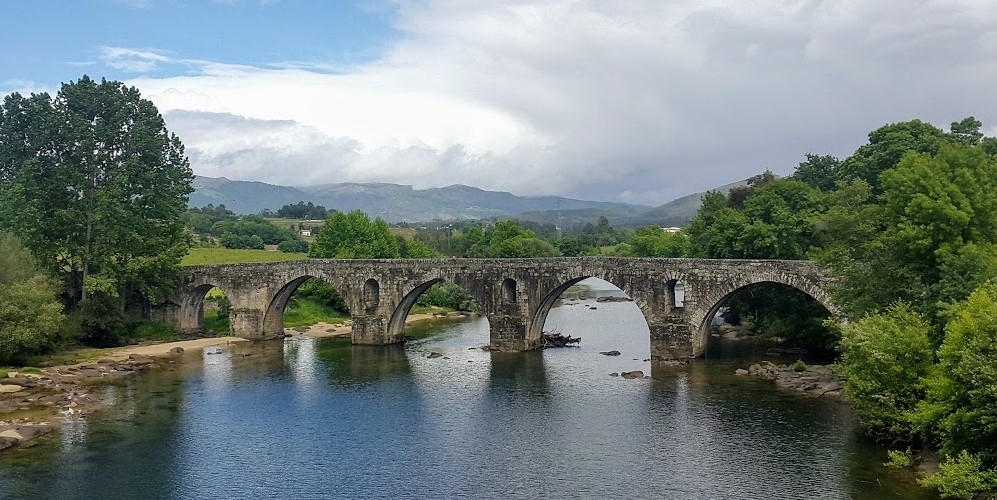
Ponte Romana de Chaves, with one of its ends located in the Parish of St. Mary Major (Chaves) also called, Trajan's Bridge was built between the end of the century and the beginning of the second century AD In addition to the development of the baths is a of the best legacies of the ancient Roman Aquae Flaviae, which prevails to this day, resisting the historical floods, and strong river currents Tâmega. With about hundred and fifty feet long and a dozen arches visible. This bridge is classified as a National Monument.

Thursday, August 4, 2011

Visit the Roman bridge of Chaves - Madalena (Chaves)

Ponte Romana de Chaves, who has one of its ends to the Town of Magdalene, is also designated bridge of Trajan, and was built between the end of the century and the beginning of the second century AD
With about hundred and fifty feet long and a dozen arches visible, the works carried out in the 1930 covered some of the arches and others buried there in the construction of mansions overlooking the river and deployed. This bridge is the ex libris of the city, and is classified as a National Monument.

Wednesday, July 13, 2011

Visit the Pelourinho de Setúbal - Our Lady of the Annunciation (Setúbal)

Pelourinho de Setúbal is located in the Parish of Our Lady of the Annunciation, county and district of Setubal, Portugal. Its white marble column has a capital of Corinthian type.
It is classified as a National Monument.

Friday, June 24, 2011

Visit the Church of St. John the Baptist (Tomar)

The Church of St. John the Baptist is the late fifteenth century and has a Manueline portal surmounted by an octagonal spire.
Inside is a pulpit carved in stone, with tiles called "Diamond Tip" and sixteenth-century paintings including a Last Supper of Gregory Lopes.
The church was classified as a National Monument in 1910.