
Custom Search
Showing posts with label Castles. Show all posts
Showing posts with label Castles. Show all posts
Sunday, December 8, 2019


Monday, November 18, 2019
Visit the Torre de Bera Castle - Almalaguês
 From the Torre de Bera Castle, located in the parish of Almalaguês, only ruins remain. The century castle XII was a Celtic fortification.
Tuesday, June 11, 2019
Visit Castelo Branco Castle

The Castle of Castelo Branco, also known locally as Castle of the Templários, is located in the parish of Castelo Branco.
It was a strategic Iberian castle and was part of the Middle Ages called the Linha da Raia or Linha do Tejo. Severely damaged over the centuries, the castle of the Templars remains the most important historical-military record of the city.
As soon as the Templars took possession of Moncarche in 1209, they soon made plans for the construction of the castle. The Castle of Castelo Branco dates from that time.
From the castle of the Templars a few elements remain, though few are original.
The Torreão Românico is of the oldest type, its thick paqredes have frontal and lateral views showing a practical intention of defense in coordination with the other turrets. This turret is perhaps the oldest architectural piece in Castelo Branco.
The Gothic Tower or Tower of the Templars was nothing more than the facade of the palace of the alcaldes and commendadores. The present windows with quinine lintels have little to do with the originals, even with a first Gothic change. This torte is the Ex-libris of Castelo Branco.
The Bow is the original. This arch was the door that separated the public courtyard and courtyard from the palace. Originally the two courtyards would be at the same level, which is supposed to have been lower than the current one.
It was a strategic Iberian castle and was part of the Middle Ages called the Linha da Raia or Linha do Tejo. Severely damaged over the centuries, the castle of the Templars remains the most important historical-military record of the city.
As soon as the Templars took possession of Moncarche in 1209, they soon made plans for the construction of the castle. The Castle of Castelo Branco dates from that time.
From the castle of the Templars a few elements remain, though few are original.
The Torreão Românico is of the oldest type, its thick paqredes have frontal and lateral views showing a practical intention of defense in coordination with the other turrets. This turret is perhaps the oldest architectural piece in Castelo Branco.
The Gothic Tower or Tower of the Templars was nothing more than the facade of the palace of the alcaldes and commendadores. The present windows with quinine lintels have little to do with the originals, even with a first Gothic change. This torte is the Ex-libris of Castelo Branco.
The Bow is the original. This arch was the door that separated the public courtyard and courtyard from the palace. Originally the two courtyards would be at the same level, which is supposed to have been lower than the current one.
Sunday, April 21, 2019
Visit the Pousada de São Bartolomeu - Sé (Bragança)

The Pousada de São Bartolomeu, situated in the parish of Sé, offers panoramic views of the city and Bragança Castle. Facilities include an outdoor swimming pool.
Rooms at Pousada de Bragança have a private balcony with views of the outdoor pool and the walls of the medieval castle. It is also possible to go hiking and fishing in the surrounding area.
Rooms at Pousada de Bragança have a private balcony with views of the outdoor pool and the walls of the medieval castle. It is also possible to go hiking and fishing in the surrounding area.
Thursday, April 11, 2019
Visit the Manor of Santa Maria - Santa Maria (Bragança)

Solar de Santa Maria is located in the parish of Santa Maria, offering accommodation in Bragança in a seventeenth-century manor house in the heart of the old town, 75 meters from Bragança Castle Gardens. It has a garden with cloisters.
Visit the Military Museum of Bragança - Santa Maria (Bragança)

The Military Museum of Bragança, located in the parish of Santa Maria, occupies all floors of the Tower of Menagem of the castle of Bragança, with a total of 165 exhibition halls, arose in 1929 for the desire to preserve the memory of the military experiences of the city. Many of its pieces were donated by the inhabitants themselves and tell a story of the evolution of light weaponry between the twelfth and twentieth centuries.
Sunday, April 7, 2019
Visit the Castle of Bragança - Santa Maria (Bragança)

 The Castle of Bragança located in the parish of Santa Maria, in the historical center of the city of Bragança, is one of the most important and well preserved Portuguese castles. From the top of its walls you can see the mountain ranges of Montesinho and Sanabria (to the north), Rebordões (to the northeast) and Nogueira (to the west).
D. Sancho I (1185-1211) endowed the town with the first walled fence in 1188.
Under the reign of D. Dinis (1279-1325), it was determined to erect a second walled perimeter in 1293.
Already under the reign of D. Fernando (1367-1383), he received works of improvement. At this stage, when this sovereign was involved in the succession dispute of Castile, Bragança was surrounded and conquered by the Castilian troops, returning to the Portuguese possession only by means of the signing of the Treaty of Alcoutim (1371). The keep was built around 1439.
The castle is of oval plan and set in the quota of 700 meters above sea level, it is constituted by a fence ameada with a perimeter of 660 meters, reinforced by fifteen cubes. The walls, with an average thickness of two meters, cover the historic center of the city, occupying an area of about three hectares, and delimited four spaces, guided by two road axes, whose main is the old street of the Citadel. In its interior the visitor can appreciate the buildings of the Domus Municipalis (unique example in the country of the Romanesque civil architecture and that is believed to have had, originally, the functions of tanker). In this fence, three doors are torn (two under the invocation of St. Anthony and the Door of the Sun, to the East) and two shutters (the Door of Betrayal and the Postigo of the King's Well).
The main door of Santo António, in a perfect back arc, between two turrets, is defended by a barbican, in which is located the Door of the Village, in ogival arc. In the interior, in the square of arms, it is possible to observe the adaptations of the accesses and the platforms destined to the artillery.
In the North sector, where the installations of Battalion of Hunters # 3 were erected, stands the Tower of Menagem, of square plan, with 17 meters of width, rising to 34 meters of height, attached to the fence. In shale masonry, abundant rock in the region, in the wedges and openings granite was used. Its interior, where the dungeon and the cistern are, is divided in two floors, with rooms covered by vaults of edge, reinforced by arches torais. At first a drawbridge reached the door in a higher plane, now replaced by an external staircase, masonry attached to the north face of its armor. In the South face, half height of the tower, is a stone of arms with the coat of arms of the House of Avis. The top is crowned by cross-sectional battlements, countertops with kills, with four cylindrical guards at the vertices, dominating, on the East face and the South face, two mainelated Gothic windows. A fence, reinforced by seven cubes (three to the east, three to the west and one to the south) of circular plan, defend the exterior of the tower, delimiting an approximately rectangular space.
Also on the north side of the outer fence, next to one of the basins, stands the so-called Torre da Princesa, former Paço do Alcaide. Building of residential characteristics (torre-alcáçova), its existence is surrounded by stories, one of the most popular the legend of the Moorish princess. In historical times, it is said that it was inhabited by D. Sancha, sister of D. Afonso Henriques, as a refuge in the face of marital infidelities practiced by her husband Fernão Mendes. In her, was also imprisoned D. Leonor, wife of the fourth Duke of Braganza, D. Jaime, accused (unjustly) of adultery by the own husband. The duke ended up murdering his wife, in the Paço Ducal of Vila Viçosa, stabbing, on November 2, 1512.
In the south sector, a projection of quadrangular plant is closed by Poço del'Rei, structure XVIII with the function of defense of a cistern.
Tuesday, March 19, 2019
Visit the Castle of Tourão - Rebordãos
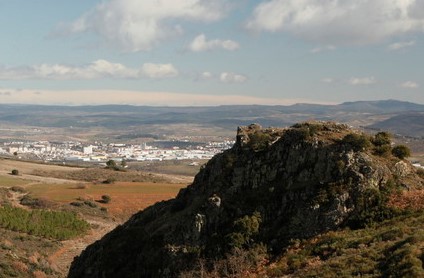
The Castle of Tourão, located in the Parish of Rebordãos, is located in a small spire in spur, in the hillside and in the northeast limit of the mountain range of the Nogueira. The first occupation of the place will have been a small fortified settlement, of the Final Bronze or Iron Age, of which there are scarce vestiges.
The second phase of occupation corresponds to the construction of a small medieval rock castle, whose occupation extends to the modern era. From this rocky castle there are still evident traces of structures, which, though heavily overturned, are still preserved in the foundations and some walls of considerable dimensions.
The second phase of occupation corresponds to the construction of a small medieval rock castle, whose occupation extends to the modern era. From this rocky castle there are still evident traces of structures, which, though heavily overturned, are still preserved in the foundations and some walls of considerable dimensions.
Monday, March 4, 2019
Visit the Castle of Alfenim - Pinela

Saturday, July 7, 2018
Visit Quinta da Mata - Semelhe

The house of Quinta da Mata, located in the Parish of Semelhe, has its origin in the castle of the century. XIII, combining several architectural styles: Gothic, Baroque and Manueline.
Sunday, May 27, 2018
Visit the Castle of Beja - Santa Maria da Feira (Beja)

The first restoration of the walls of Beja dates from the reign of D. Afonso III (1248-79), and began in 1253. The following year (1254), the village received its charter on the same terms as Santarém, confirmed in 1291 in the reign of his son, D. Dinis (1279-1325). This, in turn, continued the reconstruction works, reinforcing and enlarging the walls and towers (1307) and began the construction of the keep (1310).
Until the 17th century, Castelo de Beja was the object of various extensions and modernizations, particularly in the context of the Restoration War of Portuguese Independence, when it was reinforced by bastions according to the design of the military engineer and French architect Nicolau de Langres, approved by the engineer and chief cosmographer of the realm, Luís Serrão Pimentel, and General Agostinho de Andrade Freire (1644). In the period from 1669 to 1679 the works were directed by the engineers João Coutinho, Diogo de Brito de Castanheira and Manuel Almeida Falcão, but they were never completed.

The Robust Tower of Menagem, in Gothic style, is considered as one of the most beautiful examples of military architecture of the Middle Ages in Portugal. It rises to forty meters high. The tower has angular counters on bushes, joined by balconies defended by pyramidal battlements. It is torn by ogival doors and twin windows, in a horseshoe arch. The rooms in its interior, richly decorated, have roofs in vault in cross of ogives.
The main door of the castle opens in an ogival arc and accesses the square of arms. Of the primitive doors still remain two of Romanesque origin: the Door of Évora, contiguous to the castle; and the arc of the Avis Gate. The Porta de Moura is defended by two turrets.
Saturday, May 26, 2018
Visit the Port of Évora - Salvador (Beja)

The Porta de Évora or Arco Romano is located next to the castle wall of Beja.
Friday, August 19, 2011
Visit the dungeon Keys - Santa Maria Maggiore (Chaves)
 The Watchtower Keys, located in the Parish of Santa Maria Maggiore, is a National Monument. The set is marked by the medieval castle, in a dominant position on the city, including rectangular donjon internally and externally, Vauban-style fortifications abaluartadas.
The medieval castle survived only part of the wall and keep. This presents quadrangular with dimensions of 12 m away for about 28 m high, divided internally on the ground floor (tank) and three floors with barrel-vaulted ceiling. In the granite walls ripping some loopholes, and the east elevation, wooden balconies. Merlons crowned by battlements and, at the corners, small semicircular balconies are supported by boulder. The first floor is accessed via a stone stairway at an angle, with guards, also of stone, and door-round arch, with torada frame, surmounted by a royal coat of arms with nineteen castles.
Saturday, August 13, 2011
Visit the Castle Garden - Santa Maria Maggiore (Chaves)
 The Castle Garden, located in the Parish of St. Mary Major (Chaves) around the Castle Keys, has exposed several archaeological findings belonging to the Museum Flaviense. These findings testify to the history of the castle and the city of Chaves.
Thursday, July 28, 2011
Visit the Castle of Monforte - Cold Water
 Monforte Castle, located in the Town of Aguas Frias, is located 825 meters above sea level and integrated defense of the valley of Chaves. Ordered the construction of D. Denis in the thirteenth century, probably on the remains of a Roman fort. This walled enclosure surrounding the town there are still some traces.
Friday, June 24, 2011
Visit the Castle of Tomar - St. John the Baptist (Tomar)
 The Castle of Tomar is located in St. John the Baptist Parish, is a crusader castle on the right bank of the river Nabão, which included, at the time of the Reconquista, the call line of the Tagus, along with others in the region, which will follow the style : the castles of Almourol, Idanha, Monsanto, Pombal and Zêzere.
The castle features elements of military architecture in the Romanesque, Gothic and Renaissance. It consists of a double ring of walls that delimit the primitive and the intramural town parade ground: one on a higher plane of irregular polygonal, with some curved faces, rising at the entrance of the Chapter House and ending at the Tower of Dona Catarina . Marks the Alcazaba and retains only the tank and the Keep on the inside, defensive figure introduced by the Templars in Portugal and has here his testimony earlier, another on a lower plane, connecting the eastern facade of the south part of the Rotunda Alcazaba, which corresponded to the fortified village of the Middle Ages. It also presents an irregular polygonal plan, developing wedge towards the East, finished in a large quadrangular tower, called Tower of the Queen.
Saturday, April 16, 2011
Visit the Moorish Castle - San Pedro de Penaferrim (Sintra)
 The Moorish Castle, located in the Parish of San Pedro de Penaferrim (Sintra), is classified as National Monument
The monument features organic plant (adapted to the terrain) with about 450 meters long and 12,000 square meters.
Erected on a rocky massif, isolated in the ridges of the Sintra hills, the top of its walls opens up a privileged view of all its rural surroundings which stretches to the Atlantic Ocean.
Its walls are composed of a double belt, exterior and interior. The East is still visible sections of the outer wall, where is the port rotation of access to the grounds. The top of the inner wall, with battlements, is covered with parapet, being reinforced by several towers.
 The walls were performed using the technique of rope and tissão that can still be seen in his best haul maintained. Loved ashlars with about 30-40 cm high, are placed alternately in width and length. These are short intervals by narrow bands of stones embedded in mortar. This technical change was above 4.5 m height, where it starts to record a lower quality, the result of a second construction phase. In another section of wall visible area of union between the different techniques used, inheritance of the different stages of intervention.
In addition to the embattled walls, towers and battlements, the set is completed by several ramps and stairs for access.
Another noteworthy element is the port in Arabic horseshoe arch.
The wall features five towers: four rectangular and one circular plan pyramid surmounted by battlements, with no more trace of the two floors and roofing system primitives.
The tower at the higher elevation of the land, also known as the Royal Tower is accessed via a staircase of 500 steps. In the Islamic period constituted themselves in the citadel. In the Christian period there appears to have lived Ribeiro, a Portuguese writer of the sixteenth century.
Saturday, March 12, 2011
Visit the Serra de Sintra

The Serra de Sintra belongs to the same mountain range of Serra da Estrela, which ends in Cabo da Roca, marking the western limit of Europe. Is about 10 kilometers from east to west and approx 5 km wide with its highest peak at an altitude of 529 meters. It has a rich fauna, with her example, fox, genets, the mole salamander, the peregrine falcon, the viper and various species of lizards. Its climate is mild with plenty of oceanic influences, and this gives it a higher rainfall compared to the rest of the Greater Lisbon area. It also follows a unique vegetation. About nine hundred species of plants are indigenous and 10% are endemic. Some of them are oak, cork oak and stone pine. Paa is an ideal place for climbing and mountaineering, since the slopes are mostly oriented to the west, which lengthens the light on summer afternoons in the Sintra hills is that we can find the Moorish Castle, the Pena Palace, the Capuchin monastery, the Palace of Monserrate.
Thursday, February 24, 2011
Visit the Castle Walls - Batagram

The walls of the castle, located in the Town of Batagram, are the ruins of the castle that would have been a Moslem fortress.
Friday, February 4, 2011
Visit Castle Germanelo - Alvorge

Germanelo's Castle, located in the Town of Alvorge, was built in 1142 by D. Afonso Henriques.
Subscribe to:
Posts (Atom)