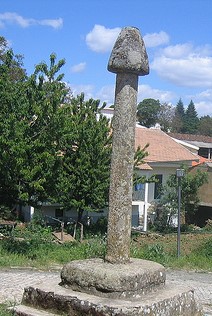
The Pelourinho of Vila Franca de Lampaças is located in Sendas parish and is classified as a Building of Public Interest.


 Pelourinho Arcos (Tabuaço) was built in the sixteenth century and was rebuilt in 2001. It features a square platform with three steps. On this platform is a square plinth, which part of the stem topped with small prismatic octagonal ring. The capital prismatic octagonal frame is delimited by the concave bottom and the top and crowned by pyramid.
 Pelourinho Coruche, was rebuilt in 1941 from original elements of the centuries XV / XVI, presents a blow which staggered five steps based on a hexagonal base with double plinth, Scotland and bocelão faceted. The torso is coiled stem rosettes and has square, interrupted by the center ring decorated with saw teeth, balls and tickets. It features an armillary sphere, cross Avis, machines, weapons and cross the town of Calatrava.
 The Pillory of St. Nicholas (March Canavezes) consists of four steps up a podium which supports a cylindrical column, surmounted by a quadrangular element, finished at its corners by four smaller pyramids and more, in the center.
 Border Pelourinho was built in the sixteenth century and retired in 1865, was rebuilt later in 1930 looking to maintain part of the original design. The revivalist architecture introduced him, however, new elements like the ring of the stem.
 The Pillory Vide is situated opposite the Town Hall, is made of granite and is based on a square platform with three steps on which rests the octagonal shaft. Its conical helm flanged bearing the Cross of Avis on the opposite side of the royal arms.
 Pelourinho de Sintra, located in the Parish of Saint Martin (Sintra), is to copy the old March Manueline overthrown in 1854. it is a work of the master stonemason Joseph Fonseca, erected in 1940. Presents three steps that serve as a hexagonal punch the octagonal base of the pillory. This, helical shaft adorned with rosettes and quadripétalas presents, half, two strings separated by a concavity. The capital boasts with acanthus leaves, in the shot, and iron pine cone to the top. The entablature emerge four irons bondage.